





You need an account to access this content
Create a free account and get access to all downloads and more!

At ComAp, every product goes through a carefully managed Product Lifecycle Management process. This ensures customers always receive reliable, up‑to‑date solutions with full transparency about product availability, support, and long‑term continuity.
Our Product Lifecycle Management (PLM) framework defines each stage of a product’s life - from early concept, through development and active sales, all the way to end‑of‑life. At every stage, we clearly communicate how the product is supported, manufactured, priced, and planned so customers can make informed decisions.
With this structured approach, we guarantee:
This lifecycle transparency helps customers plan their projects confidently, select the right products for the future, and maintain long‑term continuity in their applications.
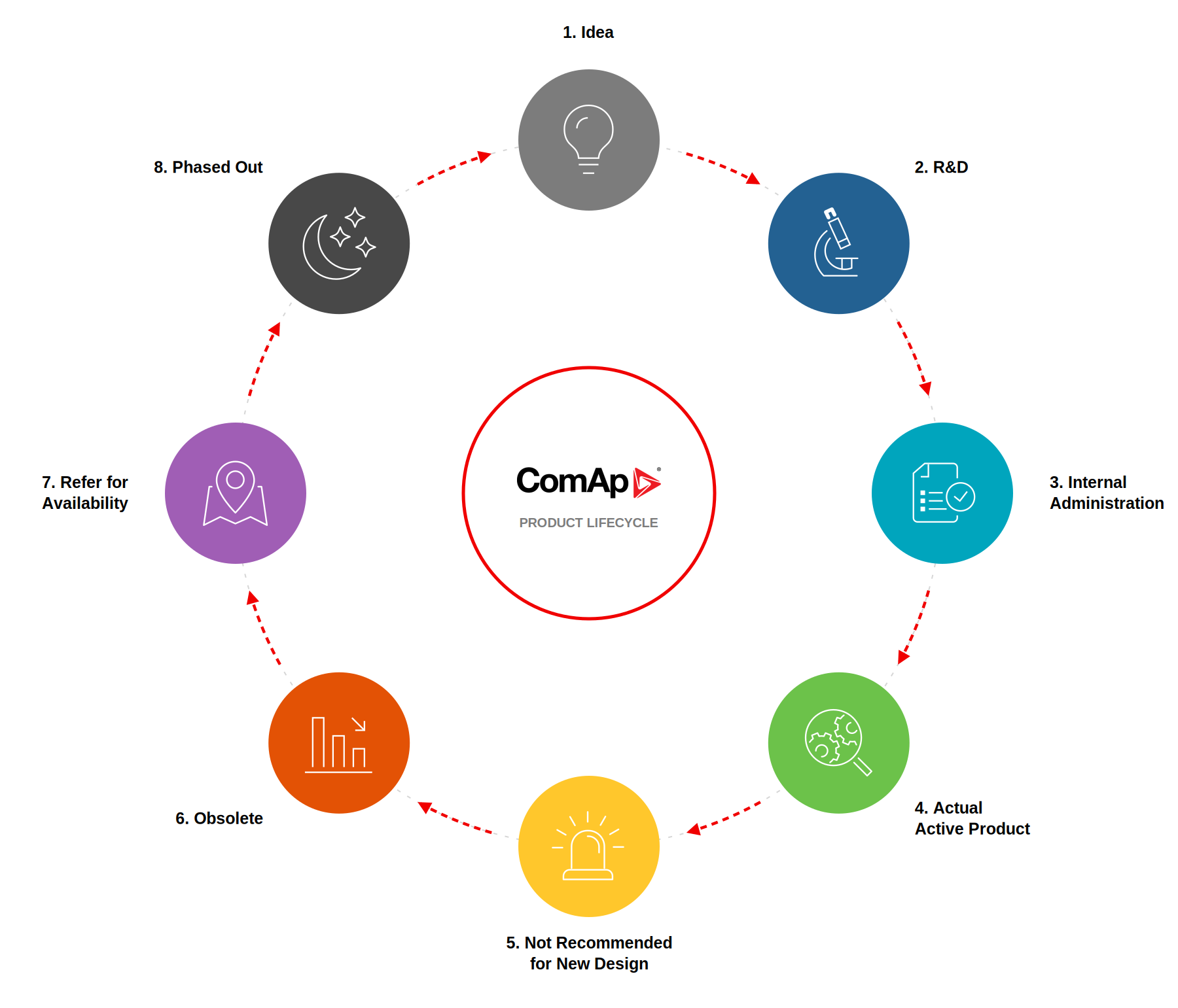
Idea
The earliest concept stage. Products here are only being considered internally and are not yet developed, produced, or available. This stage ensures we explore new ideas that may become future solutions.
R&D (Research & Development)
The product is now actively being developed. Prototypes and test units may exist, but the product is not yet available for purchase. This stage ensures the solution is designed, tested, and validated to meet our quality standards.
Internal Administration
Final preparations before launch. The product enters the price list, internal systems are completed, and the sales team is trained. Customers may see the product announced, and pre‑orders or opportunities may be created, but delivery is still blocked until launch.
Actual (Active Product)
The product is fully available, regularly manufactured, supported, and continuously improved. This is the main commercial phase where customers can buy, implement, and rely on the product with full support and stock availability.
Not Recommended for New Design
A successor product now exists. The current product remains fully available and supported, but we recommend using the new version for future projects. This phase gives customers time for smooth transition planning.
Obsolete
The product is approaching the end of its lifecycle. It is still available and often still produced based on demand, but it receives no further upgrades. Customers receive an End‑of‑Life announcement, and a “Last Time Buy” period ensures they can place final orders if needed. It usually lasts 12 to 24 months.
Refer for Availability
The product is no longer produced regularly and may be available only on request. Delivery depends on component availability and feasibility. Pricing is adjusted, discounts are no longer offered, and the product stays in this phase for up to 5 years.
Phased Out
The final stage. The product can no longer be manufactured due to unavailable components and is fully discontinued. It is not available for sale under any circumstances.

Didn't find what you were looking for? Contact us, we’ll be happy to answer any questions you may have and help you with your business needs.
Interested in another country? Find your local representative.


-off-grid.jpg?f=Avif&w=600&h=440&t=34&l=0&cw=4032&ch=2956&q=70&v=639070169905393967)


.jpg?f=Avif&w=600&h=440&t=48&l=0&cw=5712&ch=4188&q=70&v=639033106938047093)


